

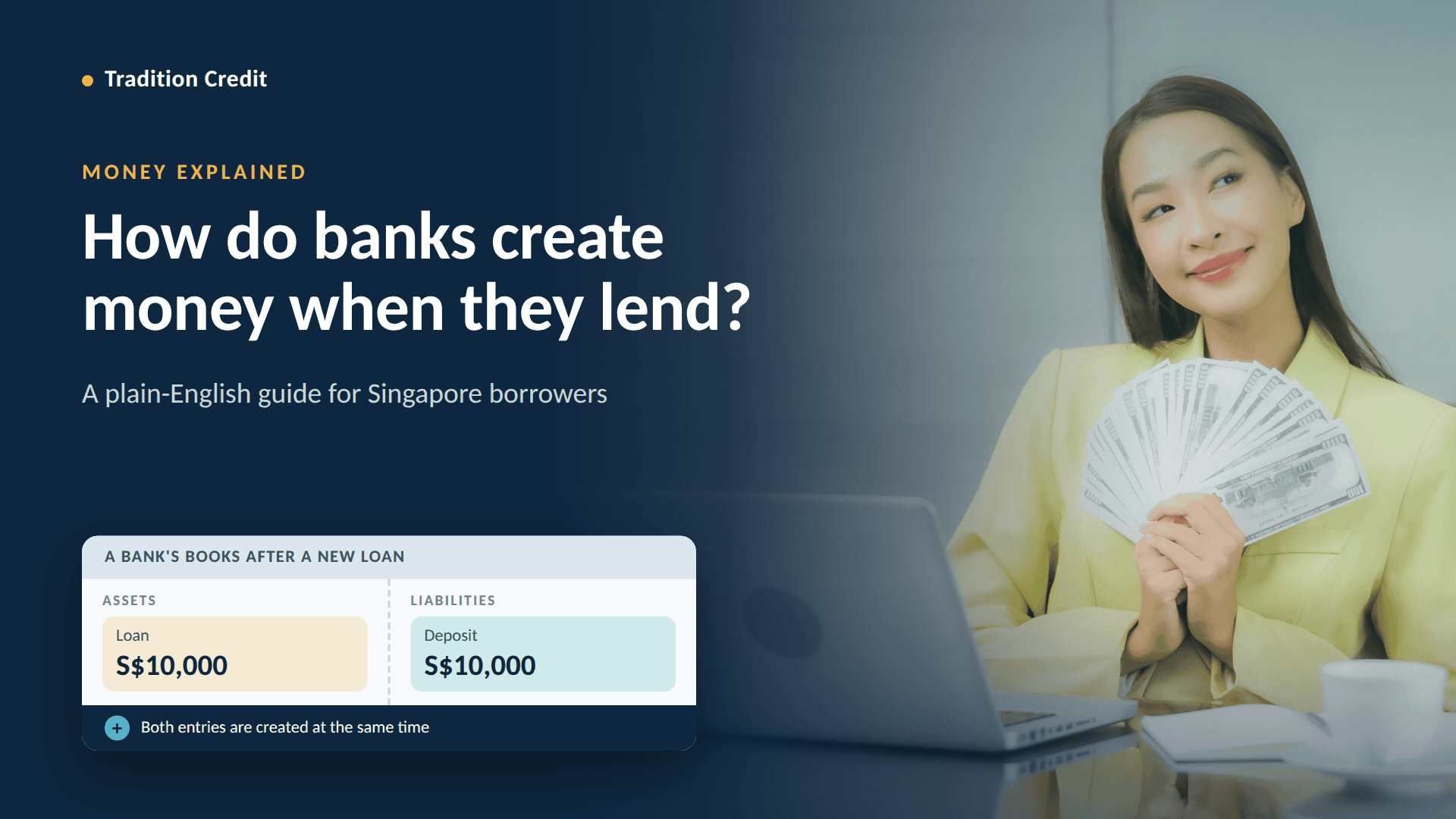
If you take out a S$10,000 personal loan from a bank in Singapore, where does that S$10,000 come from? It is easy to picture it coming out of a vault, or out of someone else’s savings. According to the Monetary Authority of Singapore (MAS), the bank creates it. Bank lending is a primary source of money creation: when a bank makes a loan, it creates a matching deposit in the borrower’s account at the same time, adding to the money supply.
That is what people mean when they say banks create money “out of thin air”. It sounds strange, but it is an accounting process with a repayment obligation attached, not free money. This article walks through how it works, what stops banks from lending without limit, and why a licensed moneylender such as Tradition Credit works differently. It ends with what all of this means for anyone thinking about borrowing.
How a bank loan creates new money
Go back to that S$10,000. The moment a commercial bank in Singapore approves it, two entries appear on the bank’s books. One is a S$10,000 loan, which the borrower owes the bank. The other is a S$10,000 deposit in the borrower’s account, which the bank owes the borrower.
The amount of deposit money in the economy is now S$10,000 higher. That is why MAS describes bank lending as a primary source of money creation. The process is different from simply handing one customer’s existing deposit to another.
MAS’s own stylised bank balance sheet shows the same picture, with loans on the assets side and deposits on the liabilities side. The loan is an asset because the borrower must repay it. The deposit is a liability because the bank owes that money to the borrower.
This is why “out of thin air” is only half the story. The deposit comes from an accounting entry, not from a vault or a printing press, and no notes or coins are printed along the way. But the money is not free. It exists alongside a debt that someone has promised to repay.
Two kinds of money in Singapore
A bank deposit counts as money because Singapore has more than one kind of money. MAS describes the country’s monetary system as two-tier. MAS issues central bank money: the notes and coins in your wallet, issued under the Currency Act 1967, and the digital reserves that commercial banks hold. Commercial banks issue the other kind, deposits, which are the main form of Singapore-dollar digital money held by households and businesses.
| Form of money | Issued by | Held by |
|---|---|---|
| Notes and coins | MAS, under the Currency Act 1967 | The public |
| Digital reserves | MAS | Commercial banks |
| Bank deposits | Commercial banks | Households and businesses |
So the money in your bank account is not a stack of notes set aside for you. It is a deposit, which is a liability of your bank. Deposits also make up most of Singapore’s money supply: in its November 2021 paper on a retail central bank digital currency, MAS noted that commercial bank deposits made up 92% of it.
This also explains the difference between bank lending and “printing money”. When people talk about a government printing money, they usually mean new currency or new central bank money, which in Singapore is issued by MAS. Commercial banks create deposit money when they lend, not notes or coins.
Why banks cannot lend without limit
If a bank can create money by lending, what stops it from lending endlessly? In Singapore, regulation comes first. MAS states that banks’ credit creation is constrained by MAS’s monetary policy stance and by regulations such as capital and liquidity requirements. MAS’s exchange rate policy also affects the demand for credit. Banks themselves are licensed and regulated by MAS, which lists them in its Financial Institutions Directory.
Then there is the borrower. Every new loan needs someone the bank believes will repay it, and MAS expects banks to assess each customer’s risk profile and manage credit risk when granting credit. DBS, for example, says the rate it offers on its personal loan depends on the applicant’s credit and income profile.
This is also why a bank can turn down a loan application even though, in principle, it could create the money. A rejection is a decision about repayment risk under the bank’s own criteria, not a sign that the bank has run out of money.
Where licensed moneylenders fit in
Licensed moneylenders in Singapore are not banks, so they cannot create money through lending the way banks do. MAS treats bank deposits as a form of money in their own right, which is why bank lending adds to the money supply. When a licensed moneylender grants a loan, it pays the loan amount into the borrower’s bank account from money that already exists, so it moves money rather than creating it.
That difference comes with a separate set of rules. Licensed moneylenders in Singapore are regulated by the Registry of Moneylenders at the Ministry of Law (MinLaw), under the Moneylenders Act and the Moneylenders Rules. Banks, by contrast, are licensed and regulated by MAS. The Moneylenders Rules set a minimum paid-up capital for licensees and require a security deposit.
A money-lending license is not a government endorsement of any lender. It means the lender is on the official register and bound by these rules. Tradition Credit’s license, No. 132/2025, appears on MinLaw’s list of licensed moneylenders.
What the law allows a licensed moneylender to charge
For a borrower, the practical questions are how much a licensed moneylender can lend and what it can charge. Both are set by law. As of September 2026, licensed moneylenders in Singapore can charge at most 4% interest per month, calculated on the principal still outstanding. Unsecured borrowing is capped across all licensed moneylenders combined, and the cap depends on your income and residency. Secured loans have no cap.
Unsecured borrowing limits across all licensed moneylenders (as of September 2026)
| Annual income | Singapore Citizens and PRs | Foreigners residing in Singapore |
|---|---|---|
| Below S$10,000 | S$3,000 | S$500 |
| S$10,000 to below S$20,000 | S$3,000 | S$3,000 |
| S$20,000 and above | 6 × monthly income | 6 × monthly income |
Source: Registry of Moneylenders, FAQs on Borrowing From Licensed Moneylenders.
Charges are capped too. As of September 2026, a licensed moneylender in Singapore can charge only interest, late interest, a late fee, an administrative fee and court-ordered legal costs, each within a legal limit. Interest, late interest, the administrative fee and late fees together can never exceed the amount of the principal.
| Charge | Legal maximum (as of September 2026) |
|---|---|
| Interest | Up to 4% per month on the remaining principal, at any income level, secured or unsecured (in effect since 1 October 2015) |
| Late interest | Up to 4% per month, only on the overdue amount |
| Late fee | Up to S$60 for each month of late repayment |
| Administrative fee | Up to 10% of the principal, charged when the loan is granted |
| Legal costs | Court-ordered legal costs only |
| Total of interest, late interest, administrative fee and late fees | Cannot exceed the principal |
As of September 2026, a cooling-off period also applies to unsecured loans, other than business loans, disbursed on or after 15 September 2026. The Registry of Moneylenders’ FAQ explains how it works.
These caps are ceilings, not the rate every borrower pays. Any lender, bank or moneylender, prices a loan based on factors such as the borrower’s credit and income profile, the loan size and tenor, how the product is structured, and the lender’s own funding and operating costs. Banks and licensed moneylenders also work under different regulators and rules. The rate a licensed moneylender quotes you depends on its assessment.
A worked example: S$3,000 over six months
To see how these caps work in practice, take a S$3,000 personal loan from a licensed moneylender, repaid in six equal monthly installments at the legal maximums as of September 2026. It would cost S$433.71 in interest plus up to S$300 in administrative fees, or S$733.71 in total charges if every payment is made on time. The legal ceiling on total charges for this loan is S$3,000, the amount of the principal.
This is an illustration using the legal maximums, not a rate quoted by Tradition Credit. S$3,000 is an example amount, not a general borrowing limit. Actual rates, and whether a loan is approved, depend on the lender’s assessment.
For a personal loan like this, the Note of Contract sets out repayment in equal installments at equal intervals, with interest calculated on the reducing balance. The schedule below follows that structure at 4% per month.
| Month | Installment (S$) | Interest (S$) | Principal repaid (S$) | Principal remaining (S$) |
|---|---|---|---|---|
| 1 | 572.29 | 120.00 | 452.29 | 2,547.71 |
| 2 | 572.29 | 101.91 | 470.38 | 2,077.33 |
| 3 | 572.29 | 83.09 | 489.20 | 1,588.13 |
| 4 | 572.29 | 63.53 | 508.76 | 1,079.37 |
| 5 | 572.29 | 43.17 | 529.12 | 550.25 |
| 6 | 572.26 | 22.01 | 550.25 | 0.00 |
| Total | 3,433.71 | 433.71 | 3,000.00 | – |
Figures are rounded to the nearest cent, with the final installment adjusted. The administrative fee of up to S$300 is charged when the loan is granted, so it is shown separately. A late payment would add late interest of up to 4% per month on the overdue amount, plus a late fee of up to S$60 for that month.
The example also shows the difference this article started with. If a bank made the same S$3,000 loan, it would create a new S$3,000 deposit. A licensed moneylender pays out S$3,000 that already exists.
What this means for borrowers
Whether a loan comes from a bank that creates new deposit money or from a licensed moneylender that lends money that already exists, the borrower’s side of the deal is the same. It is a debt that has to be repaid. A bank may create the money when it lends, but the borrower still owes all of it, plus interest.
So the useful questions are practical ones: the total cost, the repayment schedule, and whether the installments fit your budget. Lenders will ask their own questions too. Licensed moneylenders check your records with the Moneylenders Credit Bureau (MLCB) when you apply, and approval is subject to the lender’s assessment of your income, existing loans, and repayment ability.
Before you borrow: Borrow only what you can repay from your regular income, and add up your existing loan installments first. If you are already struggling with debt, MinLaw lists organizations that can help: Adullam Life Counseling, AMP, Arise2Care Community Services, Blessed Grace Social Services, Credit Counseling Singapore, One Hope Center and Silver Lining Community Services. Their current contact details are in the Registry of Moneylenders’ FAQ.
Frequently asked questions
Does bank money creation cause inflation?
Bank lending can add to inflation when credit grows quickly. MAS notes that rapid credit growth can contribute to inflationary pressures. Singapore uses an exchange-rate-centered monetary policy framework, in which MAS manages the Singapore dollar nominal effective exchange rate (S$NEER) within a policy band to achieve medium-term price stability.
Is most money in Singapore cash or bank deposits?
Most money in Singapore is held as bank deposits, not cash. In its November 2021 paper on a retail central bank digital currency, MAS noted that commercial bank deposits made up 92% of Singapore’s money supply. MAS issues the notes and coins, while commercial banks issue deposit money.
Are my bank savings protected if a bank fails?
As of September 2026, the Singapore Deposit Insurance Corporation (SDIC) insures Singapore-dollar deposits up to S$100,000 in aggregate per depositor per Deposit Insurance Scheme member. Savings, fixed and current accounts, SRS monies and prescribed products are covered, subject to the scheme rules. CPFIS and CPFRS monies are aggregated and insured separately.
How can I tell a licensed moneylender from an illegal one?
Check MinLaw’s list of licensed moneylenders before you borrow. As of September 2026, MinLaw advises borrowers to be wary of any moneylender that asks for their SingPass user ID or password, or keeps their NRIC or other identity documents. MinLaw also states that licensed moneylenders cannot advertise through SMS, phone calls or social media.
Can I stop licensed moneylenders from lending to me?
Yes. The Moneylenders Credit Bureau (MLCB) runs a voluntary self-exclusion scheme. As of September 2026, once you self-exclude, licensed moneylenders in Singapore cannot grant you new unsecured loans, except debt consolidation loans. The Registry of Moneylenders’ FAQ explains how to apply and how long an exclusion lasts.
How do I check my Moneylenders Credit Bureau record?
You can request your own report from the Moneylenders Credit Bureau (MLCB), the central record of loans and repayments involving licensed moneylenders in Singapore. The MLCB website explains how to get your report and lists its current office and hotline details.
TRADITION CREDIT CO PTE. LTD. is a licensed moneylender, licensed by the Registrar of Moneylenders, Ministry of Law (License No. 132/2025). Tradition Credit is not a bank. You can verify this license, and any other moneylender’s, on MinLaw’s list of licensed moneylenders. For questions about licensed money-lending, the Registry of Moneylenders hotline is 1800-2255-529.
If you are considering a personal loan, you can read how Tradition Credit’s personal loans work. Approval is subject to the lender’s assessment of your income, existing loans, and repayment ability.
Sources
- MAS: A Retail Central Bank Digital Currency, Economic Considerations in the Singapore Context (November 2021)
- MAS: Governance and Risk Management of Commodity Financing (2025)
- MAS: How does MAS formulate its monetary policy?
- MAS: Financial Institutions Directory (banking)
- Singapore Statutes Online: Currency Act 1967
- Singapore Statutes Online: Moneylenders Rules
- Registry of Moneylenders: FAQs on Borrowing From Licensed Moneylenders
- Registry of Moneylenders: List of Licensed Moneylenders in Singapore
- Registry of Moneylenders: Form 1, Note of Contract
- Moneylenders Credit Bureau
- SDIC: Deposit Insurance Scheme FAQs
- DBS: Personal Loan