It’s usually something ordinary. A pallet that shifts, a wet kitchen floor near the end of a long shift, a van door that catches your hand. Then comes the clinic, an MC slip, and, a day or two later, the question that keeps you up at night: what happens to my pay?
The Work Injury Compensation Act (WICA) answers most of it. If you’re hurt at work in Singapore, it pays your medical leave wages and your medical bills, plus a lump sum if the injury turns out to be permanent or fatal. Nobody has to prove the accident was anyone’s fault. The catch is timing. Full pay doesn’t last long, and the larger sums can take months, so it helps to know what’s coming and when.
What WICA pays for
WICA compensation comes in three parts: wages for the days you’re on medical leave, your medical expenses, and a one-off lump sum if the injury leaves you permanently incapacitated or, in the worst case, causes death. For accidents from 1 November 2025, these are the amounts the Ministry of Manpower (MOM) sets out.
| Compensation | What you receive | How long, or how much |
|---|---|---|
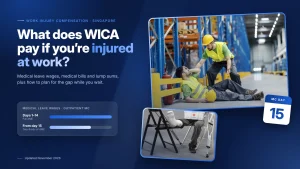
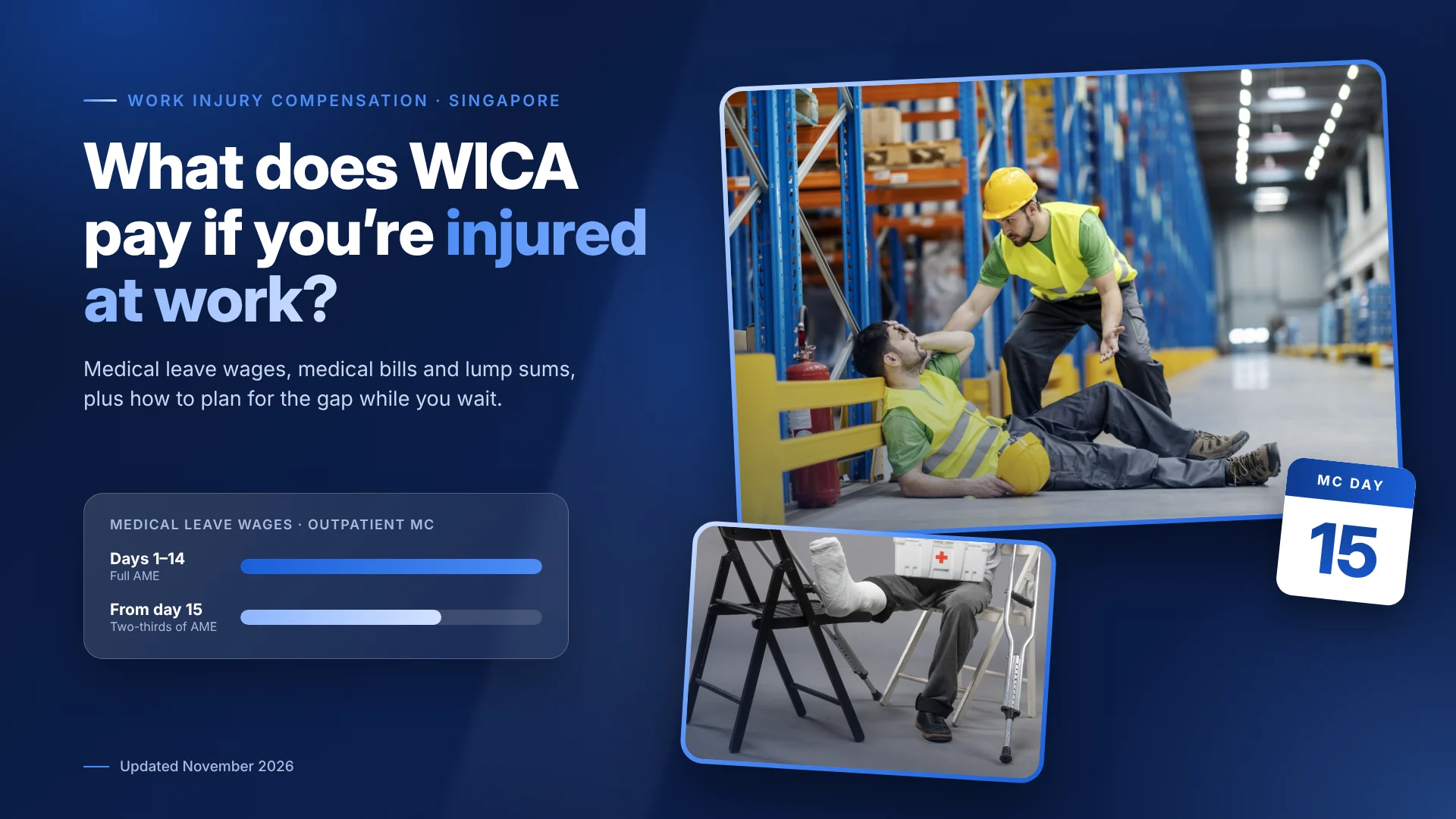
| Medical leave wages, outpatient MC | Full AME for the first 14 days, then two-thirds | Up to a year from the accident |
| Medical leave wages, hospitalisation | Full AME for the first 60 days, then two-thirds | Up to a year from the accident |
| Medical expenses | Your treatment bills | Up to S$53,000, or a year from the accident if that comes first |
| Permanent incapacity | A lump sum based on your AME, age, and incapacity rating | S$116,000 to S$346,000 × your % of incapacity, plus 25% at 100% |
| Death | A lump sum based on AME and age | S$91,000 to S$269,000 |
Source: Ministry of Manpower. Applies to accidents on or after 1 November 2025.
AME means average monthly earnings, and it isn’t the same as your basic salary. MOM generally looks at what you earned over the previous 12 months, so overtime and bonuses can push it up, while some allowances and reimbursements are left out. If you work a lot of overtime, your AME may be noticeably higher than the figure on your contract.
A few smaller rules matter in practice. Medical leave wages cover working days, so rest days and public holidays don’t count. Your employer has to pay them by your next payday. And WICA medical leave sits apart from your ordinary sick leave under the Employment Act, so a three-week MC after an accident shouldn’t eat into your sick-leave balance.
There’s some good news on deductions, too. According to CPF Board, no CPF contributions are payable on WICA compensation or on medical leave wages; CPF applies only to the actual wages you earn while on light duties. IRAS lists workmen’s compensation among payments that aren’t taxable.
Does WICA cover you?
That comes down to how you’re engaged, more than what you earn. WICA covers local and foreign employees working under a contract of service or an apprenticeship, whatever their salary, age or nationality. Since 1 January 2025, it has also covered platform workers, such as ride-hail drivers and food delivery riders.
Platform workers are compensated on a different basis. Instead of AME, the starting point is average daily earnings (ADE), after a fixed deduction for running costs: 60% if you drive a car, van, lorry or truck; 35% on a motorcycle, power-assisted bicycle or motorised PMD; 20% on a bicycle, on foot or by public transport. There’s no light-duty pay, and an injury while you’re waiting for a job to come in generally isn’t covered.
Some people fall outside WICA altogether. The self-employed and independent contractors aren’t covered. Domestic workers are outside it too; their employers have to buy personal accident insurance for them instead. The same goes for uniformed personnel in services such as the SAF, SPF and SCDF.
Where you were matters as well. On the way to or from work, you’re covered only if you were in company-provided transport; public transport, your own car, or a lift from a friend doesn’t count. Travel during the workday for the job is covered, however you get around, as long as you didn’t make a personal detour. Working from home under an arrangement your employer approved can be covered too, though cooking lunch or doing the laundry that day isn’t.
From the accident to the cheque: a timeline
WICA claims follow a fairly predictable path. Here’s roughly how one unfolds for an employee, and what’s on you at each point.
The day it happens. Tell your supervisor or employer as soon as you can, even if the injury seems small, because late notice can slow the claim down. For accidents since 1 September 2020, your employer notifying MOM is what starts the claim, so there’s no separate form for you to file. If your employer insists the accident wasn’t work-related and won’t report it, you can go to MOM yourself. Start a folder that day for MCs, receipts, and any letters you’re given.
Days 1 to 14 of outpatient MC (1 to 60 in hospital). You’re paid full AME for working days on medical leave by your next payday. Medical bills covered by WICA aren’t yours to settle: your employer can’t recover them from you.
Day 15, or day 61 after a hospital stay. Pay drops to two-thirds of AME. Say your AME is S$2,400. From here you’d receive roughly S$1,600 a month, about S$800 less, while the rent and the phone bill stay exactly where they were. (That’s rounded to a monthly figure; actual payments cover working days only.) For most people, this is when money starts to feel tight.
While you recover. If the injury might be permanent, it can’t be assessed until it has stabilised, and that waiting is often what stretches a claim out. Designated insurers have to give you a hotline and an email address for claim updates; if you still can’t get an answer, turn to MOM.
When the notice arrives. If your employer’s insurance policy started on or after 1 January 2021, the designated insurer sends a Notice of Computation; for older policies, MOM issues a Notice of Assessment. Read it closely. You have 14 days from the date a Notice of Computation is served to object.
Within 21 days of an accepted notice. If nobody objects, the compensation cheque has to be issued within 21 days. MOM says most claims are processed within eight months.
One year after the accident. Medical leave wages and medical expense coverage both stop at the one-year mark. It’s also, generally, your deadline for choosing between WICA and suing your employer.
If you lose your job along the way. Your entitlement doesn’t end when your employment or your work pass does. If you believe you were wrongfully dismissed, you generally need to file a claim with the Tripartite Alliance for Dispute Management (TADM) within one month of your last day.
Should you sue your employer instead?
You can claim under WICA or sue under common law, but not both for the same injury. WICA is the simpler route: you don’t need to prove anyone was negligent or hire a lawyer, but the payout follows a formula with set limits. A common law claim has no statutory cap, but you’d have to prove fault, and you will need a lawyer.
You generally have a year from the accident to decide. If you start under WICA and then change your mind, you can withdraw before the notice is issued, or within 14 days of it (28 days if there’s an objection). Get legal advice before taking that step, because once compensation is accepted, the common law route closes.
Getting through the two-thirds months
Start by finding out exactly when money will arrive. Ask HR which pay day your medical leave wages will land on, and ask the insurer where your claim stands and whether anything is missing from the file. A date turns a vague worry into something you can plan around.
Then look at what’s going out. Rent, your phone line, and utilities are the bills most people want to protect, so contact those providers early if a payment is going to be late. A short delay is usually easier to arrange before a bill falls overdue than after.
Free help exists, depending on who you are:
- Work Permit and S Pass holders: the Migrant Workers’ Law Centre at MWC (6536 2692) gives free legal advice on workplace injuries, salary disputes and moneylending problems.
- Singapore Citizens and PRs: if the household is struggling, ComCare is worth a look, though it has its own eligibility rules.
- Anyone already worried about debts: Credit Counselling Singapore is one of the organisations that help with debt, including cases involving bank loans and cards.
Platform workers feel the step-down differently: the two-thirds applies to ADE after the expense deduction, and there’s no light-duty pay to fall back on. The self-employed have it hardest of all. With no WICA coverage, the gap is their whole income for as long as they can’t work.
Is a loan sensible while your claim is still open?
Sometimes, for a short and specific gap, once you know roughly when your money is coming. Keep one thing in mind, though: a personal loan is a separate contract from your WICA claim. If the claim is reduced, rejected, or simply slow, you still owe the lender on the agreed dates.
That’s why a loan fits some situations better than others. It makes more sense when the claim isn’t disputed, the amount is small, and you could keep up the repayments from your two-thirds pay if the cheque came late. It makes much less sense if your employer or the insurer is contesting the claim, if you’re counting on a permanent-incapacity sum that hasn’t been assessed yet, or if the money would go towards clearing another debt.
If you do borrow from a licensed moneylender, one rule is especially relevant here. Interest is capped at 4% a month and is charged only on the principal you still owe, according to the Registry of Moneylenders’ borrower FAQ. So if your compensation arrives earlier than expected, clearing the loan sooner can reduce the interest you pay from then on. Ask about the early-repayment terms before you sign. The rest is in our explainers on how much you can borrow, what licensed moneylenders can charge, the three-day cooling-off period, how the MLCB differs from your bank credit report, and how to check a moneylender’s licence.
A rule of thumb before you decide: borrow against money you know is coming, not money you’re hoping for. If the repayments only work once the claim pays out, waiting is the safer choice.
From the team at Tradition Credit
TRADITION CREDIT CO PTE. LTD. holds Licence No. 132/2025 from the Ministry of Law’s Registrar of Moneylenders. If your claim is on track and there’s a particular bill to cover in the meantime, give us a call. We’ll look at whether a small loan makes sense for you, or whether holding on for the cheque is the better plan. Any loan depends on our assessment of what you earn, what you already owe, and what you can afford to repay.
205 Bedok North Street 1, #01-371, Singapore 460205 · 6283 1323
Whoever you borrow from, make sure their name is on the Ministry of Law’s list of licensed moneylenders first.
Official pages behind this article
- Ministry of Manpower: Types of compensation under WICA
- Ministry of Manpower: Who is covered
- Ministry of Manpower: Eligible claims
- Ministry of Manpower: For employees: how to claim
- Ministry of Manpower: WICA versus common law
- Ministry of Manpower: Work injury compensation for platform workers
- CPF Board: Are CPF contributions payable on compensation given under WICA?
- IRAS: Lump sum payments
- Tripartite Alliance for Dispute Management: File an employment claim
- Migrant Workers’ Centre: Migrant Workers’ Law Centre @ MWC
- Ministry of Social and Family Development: ComCare
- Registry of Moneylenders, Ministry of Law: FAQs on borrowing from licensed moneylenders
- Ministry of Law: List of licensed moneylenders