

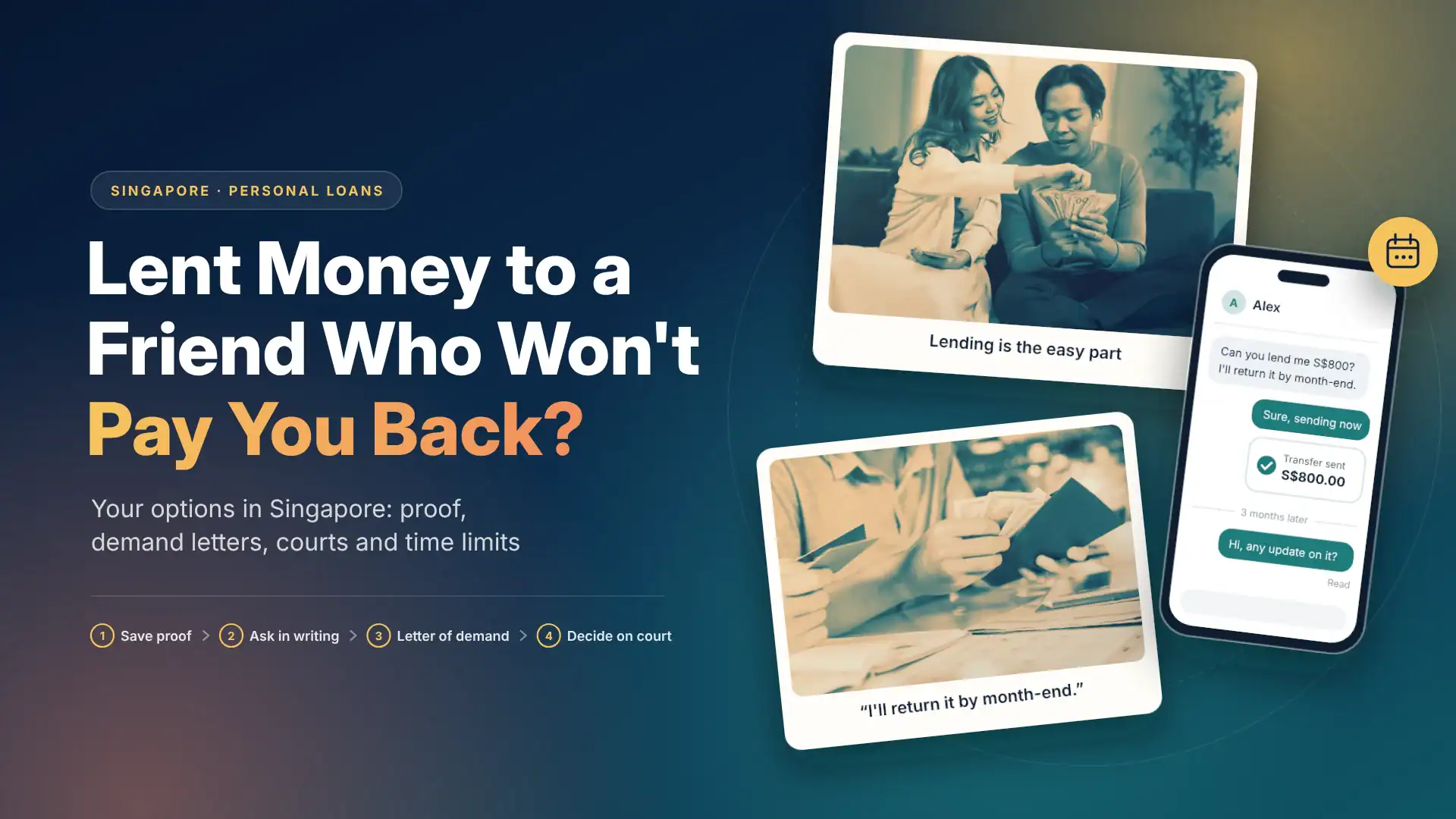
Nobody lends a friend money expecting to end up researching court claims. It usually goes something like this. They’re short before payday, you PayNow them S$800, and they promise it back by month-end. Month-end passes. Then another. Your last message shows two blue ticks and no reply.
If that’s where you are, here’s the honest picture. In Singapore, an unpaid loan between friends is almost always a civil matter, so the police won’t chase it for you, and the Small Claims Tribunals probably can’t hear it. What you can do is build your proof, ask properly, and then decide calmly whether a court claim is worth the time and money. How well that goes depends on three things: whether it was really a loan, what you can show, and how long ago repayment was due.
First question: was it a loan, or a gift?
It feels obvious to you. A court will want evidence. What counts is what you both intended when the money changed hands, and above all whether your friend agreed to pay it back.
A High Court decision from September 2026 shows how this plays out. In Chander Agarwal v Lee Xiu Hui Felicia [2026] SGHC 185, a man tried to recover money he’d spent during a relationship, arguing it had been lent. The court found it was a gift, partly because there was no objective evidence that he’d been asked for loans or promised repayment. Spending on someone you’re close to doesn’t turn into a debt later, however things end.
So be realistic. If most of the “loan” is dinners, trips and presents, you’ll struggle. If there was a clear ask and a clear promise, you’re on firmer ground.
Your evidence is probably sitting in your phone.
Before any awkward conversation, gather what you have. Do it now, while your friend’s messages are still there to save.
- The ask. Any message where they asked to borrow or mentioned paying you back. “Can you lend me S$800 till payday?” says more than a bank record ever will.
- The money. PayNow or bank transfer records, with dates. A transfer note that says “loan” helps too.
- The promises since. Every “next week, I promise” and “sorry, will settle soon”. Export the whole chat rather than cropping a few screenshots, so the dates and context survive.
- People who knew. Anyone who saw you hand over cash or heard the arrangement.
- The IOU, if there is one. Keep the original somewhere safe.
None of these wins a case on its own. A transfer record shows you paid; it doesn’t show your friend agreed to repay. Put together, they tell the story a court would need to hear.
The six-year clock
Under section 6 of the Limitation Act, claims founded on contract generally have to be brought within six years of when the cause of action accrues. For a friend loan, that’s usually when repayment fell due, the “end of the month” they promised, rather than the day you sent the money.
The clock can restart. Under sections 26 and 27, a written, signed acknowledgment of the debt or a qualifying part-payment can give you a fresh start. Not every chat message or small transfer will count, though, so if the loan is getting close to six years old, speak to a lawyer before relying on it.
Six beliefs that cost people their money back
“The police will make them pay.” Not usually. In Singapore, failing to repay a debt isn’t cheating by itself. It may be a criminal matter if your friend deceived you to get the money in the first place, and you can make a police report if you believe that’s what happened. Recovering the money, though, still tends to happen through the civil route.
“I’ll file at the Small Claims Tribunal. It’s cheap and quick.” Check first. An ordinary loan between friends isn’t one of the claim types listed in the Small Claims Tribunals Act, and the Judiciary’s eligibility page lets you test your case before you pay any fee.
“The PayNow receipt proves it.” It proves you paid. It doesn’t prove they promised to repay, which is why the messages around the transfer matter so much.
“They’ve blocked me, so it’s over.” Being blocked doesn’t cancel a debt. Send your written demand to their last known address instead.
“A post on Facebook will shame them into paying.” It’s more likely to cause you problems. Publicly naming someone over a debt can expose you to legal claims, such as defamation or harassment, depending on what you write. Keep it private and on paper.
“I’d need a lawyer, and I can’t afford one.” A lawyer isn’t automatically required, and there’s free advice to help you get started. More on both below.
How to bring it up without wrecking the friendship
This is the part most people dread, and it’s often where the money actually comes back. A lot of people who owe a friend aren’t villains. They’re embarrassed, behind on other bills,s and avoiding the subject as much as you are.
Start with a friendly message or a coffee, and make it easy to say yes. Instalments help. “Could you do S$200 a month from your next payday?” is easier to agree to than “I need the S$800 back.”
If that goes nowhere, put it in writing. Keep it short and factual: how much you lent, when, what was agreed, ed and the date you’d like to be paid by. Leave the frustration out. This message could end up in front of a judge.
After that, a lawyer’s letter of demand shows you’re serious and spells out what happens next. Mediation is worth a try if you both still want to settle things quietly. You don’t have to follow every step in order; use the ones that fit.
Thinking about a debt collector? Check that any agency you hire is licensed. Under the Debt Collection Act 2022, debt collection companies have needed a licence since 1 March 2024. And steer clear of anyone who threatens or harasses you on your behalf.
Is a court claim worth it for you?
Ask yourself four things. Is the amount larger than what a claim could cost in fees, time, and stress? Can you show they agreed to repay? Do you know where they live? And if you win, can they actually pay?
If the answers point to going ahead, this kind of claim usually belongs in the Magistrates’ Court. It hears civil claims of up to S$60,000, which start with an originating claim under the Rules of Court 2021 and follow what the Judiciary calls a simplified civil process. Older guides still talk about a “writ of summons”; claims filed since 1 April 2022 use an originating claim instead.
Costs come in layers. The Judiciary publishes estimates of court filing and service fees, but lawyers’ fees and your own time sit on top. For free advice, Pro Bono SG keeps a list of legal clinics around Singapore, though each clinic sets its own eligibility. If you’re on a Work Permit or S Pass, the Migrant Workers’ Law Centre @ MWC offers free legal advice.
Has your friend moved overseas? Then it gets harder. The Small Claims Tribunals can only hear claims served on someone in Singapore, and other courts have their own rules for serving papers abroad. Get legal advice before you spend anything.
Winning isn’t the same as being paid.
A judgment is a court order, not money in your account. A lawyer can tell you which ways of enforcing it suit your case.
Bankruptcy sits at the far end. Under section 311 of the Insolvency, Restructuring and Dissolution Act 2018, a bankruptcy application needs a debt of at least S$15,000 that’s liquidated and immediately payable, owed by someone who can’t pay it. It’s a heavy step to take against a friend, and it won’t produce money that isn’t there.
At some point, stopping may be the sensible call. That isn’t losing. It’s deciding not to pour more into a debt that probably won’t come back.
When their silence leaves you short
Sometimes the real problem isn’t the principle. It’s the bills. The S$800 you lent was your rent buffer, and now the month doesn’t add up.
If you’re weighing a personal loan to cover the gap, keep one thing in mind: it’s your debt, on its own schedule, whether or not your friend ever pays you back. Size it to what your income can carry, not to what you’re owed. And if your friend does settle up just after you borrow, unsecured non-business loans from licensed moneylenders come with a three-business-day cooling-off period. Cancel inside that window, and you won’t pay interest, although part of the approval fee can be kept.
Your income sets the ceiling on what you can borrow (how the limits work), and the law caps what a licensed moneylender can charge (interest and fees explained). If your friend offers to take a loan to repay you, the same logic applies to them: it only helps if they can genuinely afford the repayments.
Next time a friend asks
You’ll probably lend again. Most people do. Just do it differently.
Write it down before any money moves: who is lending to whom, how much, that it must be repaid, and by when. A short note you both sign, with a copy each, is a good start. No template guarantees a court will enforce it, but a clear record settles most arguments before they begin.
Think twice about adding interest. Section 3 of the Moneylenders Act 2008 presumes that anyone who lends money in return for repayment of a larger sum is a moneylender, unless the contrary is proved. Whether that affects you depends on the circumstances, so get legal advice first.
And if lending would stretch you, it’s fine to say no. You can stay a good friend without becoming their bank.
If you do borrow, keep it to an amount your own income can repay, read every line of the contract before signing, and if debts are already stacking up, get debt advice before taking on more.
A note from Tradition Credit
TRADITION CREDIT CO PTE. LTD. holds moneylender Licence No. 132/2025 from the Ministry of Law’s Registrar of Moneylenders. If an unpaid loan has left a hole in your budget, you can call us or visit our Bedok office to look at your options. Any loan we offer depends on our check of your income, current debts,s and ability to repay.
205 Bedok North Street 1, #01-371, Singapore 460205 · 6283 1323
Every licensed moneylender in Singapore, Tradition Credit included, appears on the Ministry of Law’s list of licensed moneylenders, so you can confirm who you’re dealing with.
References
- Singapore Statutes Online: Limitation Act 1959, Small Claims Tribunals Act 1984, Insolvency, Restructuring and Dissolution Act 2018, Moneylenders Act 2008
- Singapore Courts: Chander Agarwal v Lee Xiu Hui Felicia [2026] SGHC 185
- Judiciary: Cases eligible for a small claim; Start a civil claim
- Ministry of Home Affairs: Commencement of Debt Collection Act 2022
- Pro Bono SG: Legal clinics in Singapore
- Migrant Workers’ Centre: Migrant Workers’ Law Centre @ MWC
- Ministry of Law: Mandatory cooling-off period for loans from licensed moneylenders; List of licensed moneylenders (list as at 1 October 2026)